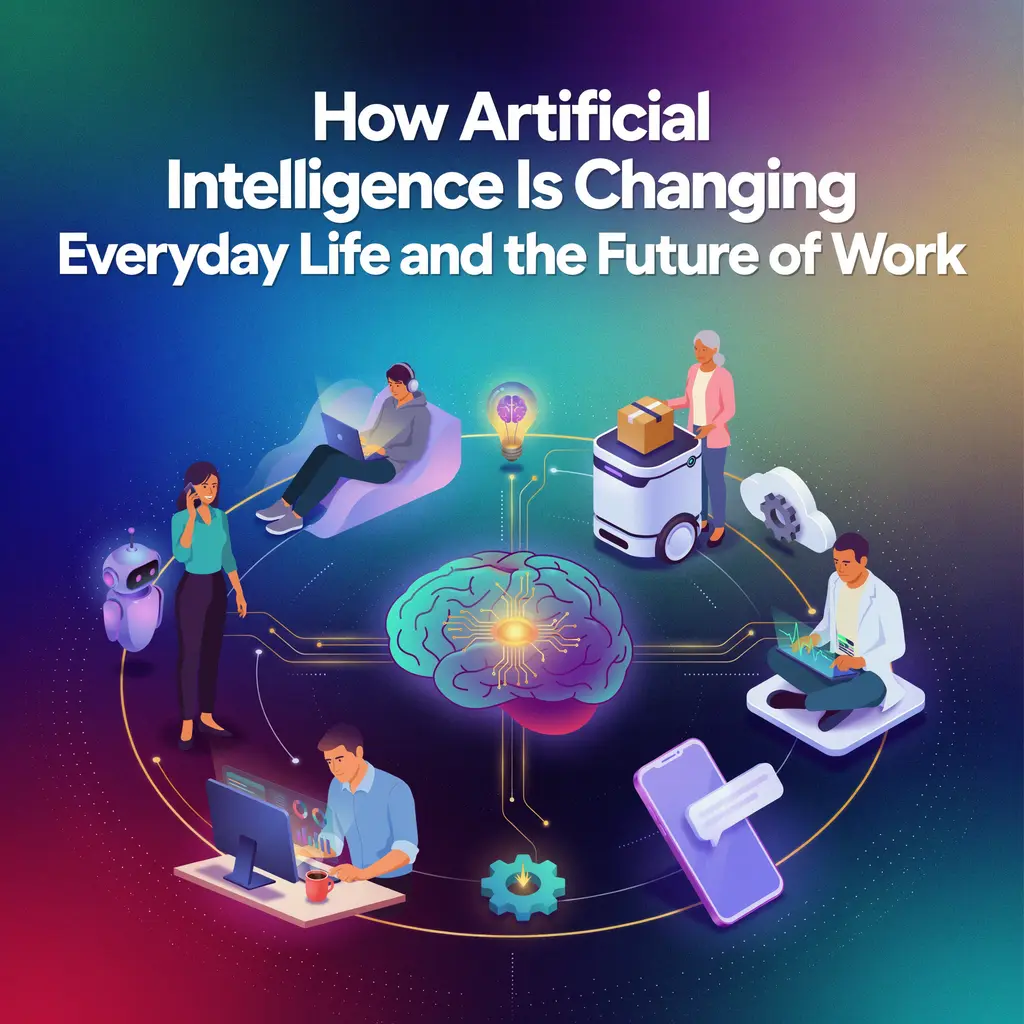
Not long ago, artificial intelligence (AI) felt like something reserved for futuristic movies and cutting-edge research labs. Today, it's quietly woven into everyday life, helping us navigate traffic, recommend what to watch next, answer customer service questions, filter spam emails, and even assist doctors in diagnosing diseases. Whether you realize it or not, AI has become one of the most influential technologies shaping the modern world.
Unlike many technological breakthroughs of the past, artificial intelligence isn't changing just one industry, it’s transforming nearly every aspect of how we live, work, communicate, shop, learn, and create. Businesses are becoming more efficient, students have access to personalized learning tools, and professionals across countless careers are discovering new ways to save time and increase productivity. At the same time, AI is raising important questions about privacy, ethics, job security, and what the future workforce will look like.
One of the reasons AI has advanced so rapidly is the explosion of data, improvements in computing power, and breakthroughs in machine learning. These developments have enabled AI systems to recognize patterns, generate human-like text, create realistic images, translate languages instantly, and perform tasks that once required significant human expertise. What was considered groundbreaking just a few years ago is quickly becoming the new normal.
The workplace is perhaps experiencing the biggest transformation. Routine and repetitive tasks are increasingly being automated, allowing employees to focus on more strategic, creative, and people-centered work. New careers centered around artificial intelligence are emerging just as older job roles evolve. Rather than simply replacing workers, AI is redefining how people collaborate with technology, creating opportunities for those willing to adapt and learn new skills.
For consumers, the benefits are equally significant. Smart assistants help organize schedules, recommendation engines personalize shopping experiences, navigation apps optimize travel routes, and AI-powered tools can summarize documents, write emails, generate ideas, and streamline daily responsibilities. Tasks that once took hours can often be completed in minutes with the right AI tools.
Of course, the rise of artificial intelligence isn't without challenges. Concerns surrounding misinformation, deepfakes, cybersecurity, algorithmic bias, and responsible AI development continue to grow. Governments, businesses, educators, and technology companies are all working to find the right balance between innovation and accountability.
Understanding artificial intelligence is no longer just for software engineers or technology enthusiasts. As AI becomes increasingly integrated into daily life, knowing how it works, and how to use it responsibly, is becoming an essential skill for professionals, entrepreneurs, students, and everyday consumers alike.
In this comprehensive guide, we'll explore what artificial intelligence actually is, how it's already influencing your daily routine, the industries it's transforming, the opportunities and risks it presents, and what the future of work may look like in an AI-driven world. Whether you're simply curious about the technology or looking for ways to use AI more effectively, this guide will help you understand one of the most important innovations of our time.
What Is Artificial Intelligence? (A Simple Explanation)
Artificial intelligence, commonly known as AI, is a branch of computer science focused on creating systems that can perform tasks that typically require human intelligence. Instead of following a rigid set of instructions for every situation, AI systems are designed to analyze information, recognize patterns, learn from experience, and make decisions based on the data they receive.
Think of AI as software that can improve at certain tasks over time. While traditional computer programs do exactly what they're told, AI is capable of adapting its responses by identifying relationships within massive amounts of information. This ability makes AI far more flexible and useful in solving complex problems.
At its core, artificial intelligence powers many of the digital experiences people use every day. When your email automatically filters spam messages, when your streaming service recommends a movie you'll probably enjoy, or when your smartphone recognizes your face to unlock the screen, AI is working behind the scenes.
Artificial Intelligence vs. Machine Learning
The terms artificial intelligence and machine learning are often used interchangeably, but they aren't exactly the same thing.
Artificial intelligence is the broad concept of creating machines that can simulate human intelligence. Machine learning is one of the primary methods used to achieve that goal. Rather than programming every possible rule, developers train machine learning models using large datasets, allowing the system to identify patterns and improve its performance over time.
For example, if you wanted a computer to recognize pictures of cats, you wouldn't manually program every feature that makes a cat look like a cat. Instead, you would feed the AI thousands, or even millions, of labeled images. Over time, it learns the characteristics that distinguish cats from other animals.
What Is Generative AI?
One of the biggest breakthroughs in recent years is generative AI. Unlike traditional AI systems that mainly analyze or classify information, generative AI can create entirely new content based on what it has learned.
Today, generative AI can:
- Write articles, emails, and reports
- Generate realistic images and artwork
- Create computer code
- Summarize lengthy documents
- Translate languages
- Brainstorm ideas
- Produce music and videos
- Answer questions in natural conversation
This technology has dramatically expanded how individuals and businesses use AI, making advanced capabilities available to anyone with an internet connection.
Narrow AI vs. General AI
Most of the artificial intelligence people use today falls into a category called Narrow AI (also known as Weak AI). These systems are highly skilled at performing specific tasks but cannot think or reason beyond their intended purpose.
Examples include:
- Voice assistants like Siri and Google Assistant
- Recommendation systems on Netflix and YouTube
- Navigation apps that calculate the fastest routes
- AI-powered customer service chatbots
- Fraud detection systems used by banks
General AI, sometimes called Artificial General Intelligence (AGI), is different. AGI refers to a theoretical system capable of learning and performing virtually any intellectual task a human can do. It would be able to reason, adapt, solve unfamiliar problems, and transfer knowledge across different domains without needing separate training for each task.
While AGI receives plenty of attention in research and popular media, it does not exist today. Current AI systems remain specialized tools rather than human-level thinkers.
Why Has AI Advanced So Quickly?
Artificial intelligence has existed as a concept for decades, but several key developments have accelerated its progress in recent years.
The first is the explosion of digital data. Every online search, purchase, social media interaction, GPS route, and uploaded photo contributes to enormous datasets that AI systems can learn from.
The second is dramatically improved computing power. Modern graphics processing units (GPUs) and cloud computing platforms can process billions of calculations in a fraction of the time older computers required, making advanced AI training possible.
Finally, breakthroughs in machine learning algorithms have made AI far more accurate and efficient. Researchers have developed models capable of understanding language, recognizing images, generating realistic content, and solving increasingly complex problems with impressive speed.
Why Understanding AI Matters
Artificial intelligence is no longer a niche technology reserved for scientists or software engineers. It is becoming as essential as the internet and smartphones, influencing nearly every industry and touching billions of lives each day.
Whether you're a student looking to learn more effectively, an entrepreneur searching for ways to automate repetitive work, or a professional hoping to stay competitive in an evolving job market, understanding the basics of AI gives you a significant advantage. The more familiar you become with how AI works, the better equipped you'll be to use it responsibly, identify its limitations, and take advantage of the opportunities it creates.
How AI Is Already Part of Your Everyday Life
Many people imagine artificial intelligence as futuristic robots or advanced computers working in high-tech laboratories. In reality, AI has already become an invisible assistant woven into countless parts of daily life. From the moment you wake up until you go to bed, you're likely interacting with AI dozens, if not hundreds, of times without even realizing it.
Whether it's helping you choose the fastest route to work, recommending your next favorite TV show, or protecting your bank account from fraud, artificial intelligence quietly powers many of the digital services we rely on every day.
Voice Assistants That Understand Natural Language
Virtual assistants like Siri, Google Assistant, Alexa, and Samsung Bixby use AI to understand spoken language and respond intelligently to requests. They can answer questions, set reminders, control smart home devices, make phone calls, play music, and even manage your daily schedule.
These assistants continuously improve because they learn from enormous datasets and advancements in natural language processing, allowing conversations to feel more natural than ever before.
Personalized Recommendations Everywhere
Have you ever wondered how Netflix seems to know exactly what movie you'll enjoy next? Or why Spotify creates playlists that match your taste so well?
Recommendation systems powered by AI analyze your viewing history, listening habits, purchases, clicks, and browsing behavior to predict what you're most likely to enjoy.
You'll find AI recommendations on:
- Netflix
- YouTube
- Spotify
- Amazon
- TikTok
- Online news websites
These algorithms help reduce information overload by surfacing content that's most relevant to your interests.
Smarter Navigation and Travel
Modern navigation apps do much more than display maps. Services like Google Maps, Apple Maps, and Waze use AI to process live traffic conditions, accidents, road closures, weather, and driving patterns from millions of users.
Instead of simply finding the shortest distance, AI identifies the fastest route in real time and can even predict delays before they happen.
Many ride-sharing services also rely on AI to:
- Match drivers with passengers
- Estimate arrival times
- Calculate pricing
- Optimize routes
- Detect unusual activity
Online Shopping That Feels Personal
Every time you browse an online store, AI is working behind the scenes.
Retailers use artificial intelligence to personalize shopping experiences by recommending products based on your browsing history, previous purchases, and items similar customers have bought.
AI also helps businesses:
- Predict inventory demand
- Prevent fraud
- Improve search results
- Offer personalized discounts
- Manage warehouse logistics
- Speed up deliveries
This creates a smoother shopping experience while helping companies operate more efficiently.
Banking and Fraud Protection
Banks process millions of transactions every day, making it nearly impossible for humans to manually identify suspicious activity.
Artificial intelligence constantly monitors spending patterns and can instantly detect unusual behavior, such as purchases from unfamiliar locations or unusually large transactions. If something appears suspicious, your bank may automatically block the transaction or notify you immediately.
AI is also used for:
- Credit scoring
- Loan approvals
- Investment analysis
- Customer service chatbots
- Financial forecasting
These systems help improve both security and customer experience.
Email Spam Filters
Opening your inbox without AI would be a frustrating experience. Every day, artificial intelligence filters millions of unwanted emails before they ever reach you.
Spam detection systems analyze countless signals, including:
- Suspicious wording
- Sender reputation
- Malicious links
- Attachments
- Sending patterns
- User feedback
As cybercriminals change their tactics, AI continuously adapts, becoming more effective at identifying phishing attempts and protecting users from scams.
Smart Homes That Learn Your Habits
AI has transformed ordinary homes into intelligent living spaces.
Smart thermostats learn your preferred temperatures and automatically adjust throughout the day. Smart lights can turn on when you enter a room, while security cameras recognize familiar faces and detect unusual activity.
Other AI-powered smart home devices include:
- Robot vacuum cleaners
- Smart doorbells
- Voice-controlled appliances
- Energy management systems
- Smart locks
- Automated irrigation systems
These technologies make homes safer, more energy-efficient, and more convenient.
Facial Recognition and Smartphone Security
Unlocking your smartphone with your face is another everyday example of AI in action.
Facial recognition systems analyze unique facial features, depth information, and thousands of reference points in just milliseconds. Modern AI can recognize subtle changes such as new hairstyles, glasses, or facial hair while maintaining a high level of security.
Beyond unlocking phones, facial recognition is used for:
- Airport security
- Identity verification
- Banking authentication
- Photo organization
- Access control systems
AI in Social Media
Social media platforms rely heavily on artificial intelligence to personalize your experience.
AI determines which posts appear in your feed by analyzing factors like your interests, interactions, watch time, and engagement history. It also recommends accounts to follow, moderates harmful content, detects spam, and even generates automatic captions for videos.
While these algorithms help users discover relevant content, they also influence how information spreads online, making responsible AI development increasingly important.
AI Is Becoming Invisible
Perhaps the most remarkable thing about artificial intelligence is that the best AI often goes unnoticed. It works quietly in the background, simplifying everyday tasks without demanding your attention.
Just as few people think about the complex systems that power electricity or the internet, AI is gradually becoming another invisible layer of modern life. As the technology continues to evolve, its presence will only grow, making daily routines more efficient, personalized, and connected than ever before.
AI in Healthcare: Saving Time and Saving Lives
Few industries have embraced artificial intelligence as rapidly, or with as much potential, as healthcare. Around the world, hospitals, clinics, research laboratories, and pharmaceutical companies are using AI to improve patient care, speed up diagnoses, reduce administrative workloads, and support medical professionals in making more informed decisions.
While AI isn't replacing doctors, nurses, or specialists, it is becoming one of the most valuable tools in modern medicine. By analyzing vast amounts of medical data in seconds, artificial intelligence can identify patterns that might take humans much longer to detect, allowing healthcare providers to deliver faster, more accurate, and more personalized care.
Detecting Diseases Earlier
Early diagnosis is often the difference between successful treatment and serious complications. AI systems are helping doctors identify illnesses at earlier stages by analyzing medical images, laboratory results, and patient histories with remarkable speed.
Artificial intelligence is now being used to assist in detecting conditions such as:
- Breast cancer
- Lung cancer
- Skin cancer
- Diabetic retinopathy
- Heart disease
- Stroke risk
- Alzheimer's disease
Instead of replacing medical professionals, AI acts as an additional layer of analysis, helping doctors spot abnormalities that could otherwise be overlooked.
Improving Medical Imaging
Radiology has become one of the biggest beneficiaries of artificial intelligence.
Every day, radiologists review thousands of X-rays, CT scans, MRIs, and ultrasounds. AI can quickly examine these images, highlight suspicious areas, and prioritize urgent cases so specialists can focus their attention where it's needed most.
This not only reduces workload but can also shorten the time patients wait for critical diagnoses, especially in busy healthcare systems.
Accelerating Drug Discovery
Developing a new medication has traditionally been an expensive process that can take more than a decade from initial research to public availability.
Artificial intelligence is dramatically speeding up this process by analyzing enormous biological datasets, predicting how different compounds interact, and identifying promising drug candidates much faster than conventional methods.
Researchers now use AI to:
- Discover new medicines
- Repurpose existing drugs
- Predict side effects
- Model protein structures
- Improve clinical trial design
These advancements could help bring life-saving treatments to patients more quickly while reducing research costs.
Personalized Treatment Plans
No two patients are exactly alike, and AI is helping healthcare move toward truly personalized medicine.
By analyzing factors such as genetics, lifestyle, medical history, and current health conditions, AI can assist doctors in recommending treatments that are more likely to be effective for an individual patient.
This approach may improve outcomes while reducing unnecessary treatments and minimizing adverse reactions.
Virtual Health Assistants
AI-powered virtual assistants are making healthcare more accessible by providing support outside of traditional doctor's appointments.
Many healthcare organizations now use AI chatbots to help patients:
- Schedule appointments
- Answer common medical questions
- Provide medication reminders
- Monitor chronic conditions
- Offer mental health support
- Guide patients through post-surgery recovery
Although these systems don't replace licensed healthcare professionals, they can improve access to basic information and reduce pressure on medical staff.
Smarter Wearable Technology
Fitness trackers and smartwatches have evolved far beyond counting steps.
Modern wearable devices use AI to continuously monitor health metrics, including:
- Heart rate
- Sleep quality
- Blood oxygen levels
- Activity patterns
- Stress indicators
- Irregular heart rhythms
Some devices can even alert users to potential health concerns before noticeable symptoms appear, encouraging earlier medical evaluation.
As wearable technology continues to improve, it is expected to play an increasingly important role in preventive healthcare.
Reducing Administrative Burdens
Healthcare professionals often spend a significant portion of their day completing paperwork and managing patient records.
Artificial intelligence helps automate many administrative tasks, including:
- Medical transcription
- Appointment scheduling
- Insurance claims processing
- Electronic health record management
- Billing
- Prescription management
By reducing time spent on routine administrative work, doctors and nurses can devote more attention to patient care.
Supporting Surgeons with Precision
Artificial intelligence is also enhancing surgical procedures.
AI-assisted robotic systems allow surgeons to perform certain operations with greater precision, stability, and control. These technologies can help minimize incisions, reduce blood loss, shorten recovery times, and improve surgical outcomes in specific procedures.
It's important to note that these robots are not operating independently. Skilled surgeons remain in full control, with AI serving as an advanced support system rather than an autonomous decision-maker.
Challenges of AI in Healthcare
Despite its many benefits, artificial intelligence also presents important challenges.
Healthcare providers must carefully address issues such as:
- Protecting patient privacy
- Securing sensitive medical data
- Preventing algorithmic bias
- Ensuring AI recommendations are medically reliable
- Maintaining transparency in AI-assisted decisions
- Complying with healthcare regulations
Because medical decisions can have life-changing consequences, human oversight remains essential. AI should enhance clinical judgment, not replace it.
A Healthier Future with Human Expertise and AI
Artificial intelligence is transforming healthcare by helping professionals work faster, make more informed decisions, and deliver more personalized care. From detecting diseases earlier to accelerating medical research and improving everyday patient experiences, AI has the potential to improve millions of lives around the world.
As the technology continues to evolve, the future of healthcare will likely be defined by collaboration rather than replacement. Doctors, nurses, researchers, and AI systems working together can achieve outcomes that neither could accomplish alone, leading to safer treatments, earlier diagnoses, and a healthier future for everyone.
AI Is Revolutionizing Education
Education has always evolved alongside technology. From printed textbooks and calculators to online classrooms and digital learning platforms, each innovation has changed how people gain knowledge. Artificial intelligence is now driving the next major transformation, making education more personalized, accessible, and effective than ever before.
Rather than replacing teachers, AI is becoming a powerful educational partner. It can adapt lessons to individual learning styles, provide instant feedback, automate repetitive tasks, and give students access to resources that were once unavailable outside traditional classrooms. Whether you're in elementary school, university, or learning a new skill later in life, AI is reshaping the way education works.
Personalized Learning for Every Student
One of the biggest advantages of AI in education is its ability to tailor learning experiences to each individual.
Traditional classrooms often follow a one-size-fits-all approach, where every student progresses at the same pace. AI-powered learning platforms can analyze how a student performs over time and adjust lessons based on their strengths, weaknesses, and learning speed.
For example, if a student struggles with algebra but excels in geometry, an AI system can provide additional algebra exercises while allowing them to move ahead in geometry. This personalized approach helps students build confidence without feeling left behind or held back.
AI Tutors Available Anytime
Not every student has access to private tutoring, but AI is making personalized academic support more affordable and accessible.
Modern AI tutors can explain complex topics, answer questions, generate practice problems, and provide step-by-step guidance across subjects like mathematics, science, history, programming, and languages.
Unlike traditional tutoring, AI assistance is available 24 hours a day, allowing students to learn whenever inspiration, or homework deadlines, strike.
Of course, AI tutors are most effective when used alongside classroom instruction and guidance from qualified educators, rather than as a complete replacement.
Faster Research and Better Study Support
Research projects that once required hours of searching through books and websites can now be completed much more efficiently with AI.
Students use AI tools to:
- Summarize lengthy articles
- Explain difficult concepts
- Organize research notes
- Brainstorm essay ideas
- Create study guides
- Generate practice quizzes
- Simplify technical language
Instead of spending most of their time gathering information, students can focus on understanding ideas, analyzing evidence, and developing critical thinking skills.
Breaking Language Barriers
Artificial intelligence is making education more inclusive by reducing language barriers around the world.
AI-powered translation tools can instantly convert lessons, documents, and educational videos into multiple languages, giving students access to learning materials that might otherwise be unavailable.
Speech recognition and real-time translation technologies also make communication easier between teachers and students who speak different languages, expanding educational opportunities across borders.
Helping Teachers Focus on Teaching
Teachers spend countless hours grading assignments, preparing lesson plans, tracking student progress, and handling administrative work.
AI can automate many of these repetitive tasks by:
- Grading quizzes and multiple-choice tests
- Tracking student performance
- Creating lesson outlines
- Generating classroom activities
- Identifying students who may need extra support
- Organizing educational resources
By reducing administrative burdens, educators have more time to focus on mentoring students, encouraging creativity, and building meaningful classroom relationships.
Improving Accessibility for Every Learner
Artificial intelligence is helping make education more accessible for students with disabilities.
AI-powered accessibility tools include:
- Speech-to-text transcription
- Text-to-speech readers
- Real-time captions
- Language translation
- Image descriptions for visually impaired learners
- Personalized learning accommodations
These technologies allow more students to participate fully in educational environments and receive support tailored to their individual needs.
Supporting Lifelong Learning
Learning no longer ends after graduation. Today's workforce constantly needs new skills as industries evolve, and AI is making lifelong learning more practical than ever.
Professionals now use AI to:
- Learn new programming languages
- Practice public speaking
- Improve writing skills
- Study foreign languages
- Prepare for certifications
- Explore entirely new careers
Because AI can adapt to different skill levels, learners can progress at their own pace without feeling overwhelmed.
Encouraging Curiosity and Creativity
Contrary to popular belief, AI isn't just useful for memorizing facts, it can also encourage creativity.
Students can use AI to:
- Brainstorm project ideas
- Generate creative writing prompts
- Design presentations
- Explore scientific experiments
- Simulate historical events
- Build coding projects
- Create artwork and multimedia content
When used responsibly, AI becomes a creative partner that helps learners explore ideas rather than simply providing answers.
Challenges and Responsible Use
Despite its many benefits, AI in education also presents important challenges.
Students must avoid becoming overly dependent on AI-generated answers, especially when completing assignments meant to develop original thinking. Relying entirely on AI can weaken problem-solving skills, reduce creativity, and make it harder to retain knowledge.
Educational institutions are also working to address concerns such as:
- Academic integrity
- Plagiarism
- Accuracy of AI-generated information
- Student data privacy
- Ethical use of AI tools
Learning how to verify information, think critically, and use AI as a support tool rather than a shortcut will become an increasingly valuable skill.
The Classroom of the Future
Artificial intelligence is transforming education by making learning more personalized, interactive, and accessible for millions of people. Teachers remain at the heart of education, but AI is giving them powerful tools to improve instruction and better support every student.
As technology continues to evolve, the most successful learners won't simply be those who know how to use AI, they'll be the ones who combine AI's capabilities with curiosity, critical thinking, creativity, and a lifelong desire to keep learning. In the classrooms of the future, human intelligence and artificial intelligence will work side by side, helping people learn faster, understand more deeply, and prepare for a world that is changing at an unprecedented pace.
AI at Work: Changing Nearly Every Industry
Artificial intelligence is no longer a futuristic concept reserved for Silicon Valley or research laboratories, it has become an essential business tool. Companies of every size, from small startups to multinational corporations, are integrating AI into their daily operations to improve efficiency, reduce costs, enhance customer experiences, and make smarter decisions.
Rather than replacing entire workforces overnight, AI is reshaping how work gets done. Repetitive tasks are increasingly being automated, while employees are shifting their focus toward creative thinking, problem-solving, relationship building, and strategic decision-making. The result is a workplace where humans and AI collaborate to accomplish more than either could alone.
Let's explore how artificial intelligence is transforming some of the world's biggest industries.
Finance: Smarter Decisions and Stronger Security
The financial sector has been using artificial intelligence for years, and its role continues to expand.
Banks and investment firms rely on AI to analyze massive amounts of financial data in real time, helping identify trends, detect fraud, assess lending risk, and support investment strategies.
Today, AI helps financial institutions:
- Detect suspicious transactions instantly
- Evaluate loan applications
- Automate customer support
- Predict market trends
- Manage investment portfolios
- Improve cybersecurity
These capabilities enable faster services while improving accuracy and reducing financial risk.
Marketing: Understanding Customers Better
Modern marketing is powered by data, and AI excels at turning that data into actionable insights.
Businesses use AI to analyze customer behavior, identify purchasing patterns, and personalize advertising campaigns based on individual preferences.
Common marketing applications include:
- Personalized email campaigns
- Product recommendations
- Social media scheduling
- Customer segmentation
- Predictive analytics
- SEO optimization
- Advertising performance analysis
- Content creation assistance
Instead of relying solely on guesswork, marketers can make informed decisions backed by real-time data.
Customer Service That Never Sleeps
Customer expectations have changed dramatically. People now expect fast answers regardless of the time of day.
AI-powered chatbots and virtual assistants allow businesses to provide 24/7 support by answering common questions, processing orders, tracking deliveries, and solving simple issues without human intervention.
Human agents still play an essential role in handling complex or emotionally sensitive situations, while AI manages routine inquiries that would otherwise consume valuable time.
Manufacturing: Building Smarter Factories
Manufacturing has embraced artificial intelligence to improve productivity and reduce costly downtime.
AI systems monitor production lines continuously, identifying potential equipment failures before they occur through predictive maintenance.
Manufacturers also use AI to:
- Inspect product quality
- Optimize supply chains
- Forecast demand
- Improve inventory management
- Increase production efficiency
- Reduce waste
These improvements help companies lower costs while producing higher-quality products.
Agriculture: Farming with Precision
Agriculture may seem like an unlikely place for artificial intelligence, but it's quickly becoming one of the industry's most valuable tools.
Farmers now use AI-powered drones, sensors, and computer vision systems to monitor crop health, detect pests, predict weather impacts, and optimize irrigation.
AI supports agriculture by helping farmers:
- Reduce water usage
- Increase crop yields
- Detect plant diseases early
- Apply fertilizers more efficiently
- Forecast harvests
- Monitor livestock health
This data-driven approach makes farming more productive and environmentally sustainable.
Transportation: Moving People and Goods More Efficiently
Artificial intelligence is transforming transportation in ways most people already experience.
Navigation apps calculate optimal routes using live traffic data, while logistics companies use AI to optimize delivery schedules and reduce fuel consumption.
Across the transportation industry, AI assists with:
- Fleet management
- Route optimization
- Predictive vehicle maintenance
- Traffic management
- Warehouse automation
- Driver safety monitoring
As autonomous vehicle technology continues to develop, AI is expected to play an even larger role in future transportation systems.
Retail: Creating Better Shopping Experiences
Retailers use AI to understand customer preferences and improve nearly every aspect of the shopping journey.
Artificial intelligence analyzes browsing behavior, purchase history, and seasonal trends to recommend products customers are most likely to buy.
Behind the scenes, AI also helps retailers:
- Forecast inventory demand
- Prevent stock shortages
- Reduce overstocking
- Detect fraudulent transactions
- Optimize pricing
- Improve warehouse operations
These efficiencies benefit both businesses and consumers through faster service and more personalized shopping experiences.
Construction: Building Smarter and Safer
Construction companies are increasingly using AI to improve project planning, safety, and resource management.
AI systems can analyze project schedules, identify potential delays, estimate material requirements, and monitor construction sites using drones and cameras.
Benefits include:
- Improved project timelines
- Better cost estimation
- Enhanced workplace safety
- Equipment monitoring
- Risk assessment
- Quality control
As infrastructure projects become more complex, AI helps construction teams make more informed decisions.
Legal Services: Automating Repetitive Work
Law firms process enormous volumes of documents, contracts, and legal research.
Artificial intelligence helps lawyers by rapidly reviewing documents, identifying relevant case law, summarizing legal texts, and detecting inconsistencies in contracts.
This automation allows legal professionals to spend more time on client strategy, negotiation, and courtroom preparation rather than repetitive paperwork.
Human Resources: Hiring More Effectively
Recruiting the right employees often involves reviewing hundreds, or even thousands, of applications.
AI helps HR teams streamline hiring by:
- Screening resumes
- Matching candidates to job descriptions
- Scheduling interviews
- Answering applicant questions
- Predicting employee retention
- Identifying workforce trends
While final hiring decisions should always involve human judgment, AI significantly reduces administrative workload and speeds up recruitment.
Human Skills Are Becoming More Valuable
Ironically, as artificial intelligence becomes more capable, uniquely human skills become even more important.
Businesses increasingly value employees who demonstrate:
- Critical thinking
- Creativity
- Leadership
- Emotional intelligence
- Communication
- Adaptability
- Ethical decision-making
- Collaboration
These are qualities that AI can support but cannot genuinely replicate.
The Future Workplace Will Be a Partnership
Artificial intelligence isn't simply changing individual jobs, it's redefining how organizations operate. Employees who embrace AI as a productivity tool will often find themselves working faster, making better decisions, and focusing on higher-value responsibilities.
The future of work isn't likely to be humans versus AI. Instead, it will belong to professionals who know how to combine human judgment, creativity, and empathy with the speed, accuracy, and analytical power of artificial intelligence. Those who learn to work alongside AI will be best positioned to thrive in the rapidly evolving workplace.
Jobs AI Is Most Likely to Automate
One of the biggest questions surrounding artificial intelligence isn't whether it will change the workplace, it's how many jobs it will change. Headlines often claim that AI will replace millions of workers, while others argue it will simply create new opportunities. The truth lies somewhere in the middle.
Artificial intelligence is exceptionally good at handling repetitive, predictable, and data-driven tasks. Jobs built around these activities are the most likely to be automated, either partially or almost entirely. However, that doesn't necessarily mean those occupations will disappear. In many cases, AI will take over routine responsibilities while people focus on higher-value work that requires judgment, creativity, empathy, and complex decision-making.
Understanding which roles are most affected can help workers prepare, adapt, and develop skills that remain valuable in an AI-driven economy.
Data Entry and Administrative Support
Data entry has long been considered one of the most automation-friendly occupations.
AI systems can extract information from documents, organize databases, complete digital forms, verify records, and process invoices much faster than humans while reducing the risk of manual errors.
Administrative assistants are also seeing many routine responsibilities automated, including:
- Scheduling meetings
- Managing calendars
- Organizing emails
- Preparing reports
- Updating spreadsheets
- Filing digital documents
Rather than eliminating administrative professionals altogether, AI allows them to focus on coordination, communication, and executive support.
Basic Customer Service
Many businesses now use AI-powered chatbots to answer common customer questions within seconds.
Routine requests such as:
- Password resets
- Order tracking
- Refund policies
- Business hours
- Account information
- Appointment scheduling
can often be resolved without human involvement.
Human representatives remain essential for handling complex issues, complaints, negotiations, and emotionally sensitive conversations where empathy and problem-solving matter most.
Manufacturing and Assembly Line Work
Industrial robots have been used in factories for decades, but AI is making automation far more intelligent.
Modern systems can inspect products for defects, adjust production lines automatically, predict equipment failures, and optimize manufacturing processes in real time.
Workers are increasingly shifting toward supervising automated systems, maintaining equipment, and solving operational challenges rather than performing repetitive assembly tasks.
Bookkeeping and Basic Accounting
Artificial intelligence is streamlining many financial processes that once required significant manual effort.
Today's accounting software can automatically:
- Categorize transactions
- Match invoices
- Generate financial reports
- Detect unusual spending patterns
- Reconcile accounts
- Calculate taxes
Accountants are therefore spending less time on routine bookkeeping and more time providing financial advice, strategic planning, and business consulting.
Content Summarization and Routine Writing
AI has become remarkably effective at producing structured, factual content based on existing information.
Tasks increasingly handled by AI include:
- Meeting summaries
- Product descriptions
- Basic reports
- Email drafts
- Social media captions
- Internal documentation
- Technical summaries
However, high-quality storytelling, investigative journalism, persuasive copywriting, brand strategy, and original thought still depend heavily on human creativity and expertise.
Scheduling and Office Coordination
Office scheduling once required constant back-and-forth communication.
AI scheduling assistants can now:
- Find mutually available meeting times
- Send invitations
- Manage calendar conflicts
- Schedule follow-ups
- Organize reminders
- Coordinate time zones
This reduces administrative overhead while allowing teams to spend more time collaborating instead of managing logistics.
Retail Checkout and Order Processing
Self-checkout systems, automated payment technologies, and AI-powered inventory management are transforming retail operations.
Artificial intelligence now assists with:
- Processing transactions
- Managing inventory
- Reordering stock
- Fraud detection
- Customer recommendations
- Warehouse fulfillment
Although automation is reducing some routine retail tasks, employees continue to play an important role in customer service, merchandising, and sales.
Basic Legal and Document Review
Legal professionals often spend hours reviewing contracts and searching through large collections of documents.
AI can rapidly identify relevant clauses, summarize lengthy agreements, detect inconsistencies, and organize legal research.
This allows lawyers to devote more attention to litigation strategy, negotiations, client relationships, and complex legal analysis.
Transportation and Logistics
Artificial intelligence is reshaping logistics through smarter planning rather than immediate full automation.
Companies increasingly rely on AI to:
- Optimize delivery routes
- Forecast shipping demand
- Track inventory
- Schedule maintenance
- Manage warehouse operations
- Improve fleet efficiency
While fully autonomous transportation is still developing, many logistical tasks are already benefiting from AI-assisted decision-making.
Automation Doesn't Always Mean Replacement
It's important to distinguish between task automation and job automation.
Very few jobs consist of only one repetitive task. Most roles involve a combination of technical work, communication, judgment, creativity, and interpersonal interaction.
For example:
- An accountant doesn't only process numbers, they advise clients.
- A teacher doesn't only deliver lessons, they motivate students.
- A nurse doesn't only record medical information, they provide compassionate care.
- A manager doesn't only review reports, they lead people and solve problems.
AI may automate portions of these jobs while making professionals more productive rather than replacing them entirely.
The Skills That AI Struggles to Replace
Despite its rapid progress, artificial intelligence still has significant limitations.
The abilities that remain uniquely valuable include:
- Critical thinking
- Creativity
- Emotional intelligence
- Leadership
- Negotiation
- Ethical judgment
- Adaptability
- Relationship building
- Strategic planning
- Complex problem-solving
These skills become increasingly important as routine work becomes automated.
The Best Career Strategy in the Age of AI
History shows that technological revolutions rarely eliminate work altogether, they change the nature of work. Artificial intelligence is following that same pattern.
The professionals who will thrive are those who learn how to use AI to increase their productivity rather than compete against it. By embracing continuous learning, developing uniquely human skills, and treating AI as a powerful assistant instead of a threat, workers can position themselves for long-term success in an economy that is rapidly evolving.
The future belongs not to those who resist artificial intelligence, but to those who understand it, adapt to it, and use it to create even greater value.
New Jobs Artificial Intelligence Is Creating
Whenever a groundbreaking technology emerges, people naturally focus on the jobs it might replace. Yet history tells a more complete story. The internet transformed industries while creating millions of careers that didn't exist just a few decades ago. Smartphones gave rise to app developers, social media managers, and digital marketers. Artificial intelligence is following a similar path.
As businesses adopt AI across nearly every sector, demand is growing for professionals who can build, manage, improve, and work alongside intelligent systems. Some of these careers require advanced technical knowledge, while others focus on communication, creativity, ethics, or industry expertise. In many cases, people won't need to become AI engineers, they'll simply need to understand how to use AI effectively within their existing profession.
AI Engineers and Machine Learning Specialists
Behind every intelligent application is a team of engineers designing, training, and improving AI models.
AI engineers develop systems that can recognize patterns, automate tasks, process language, and make predictions based on data. Machine learning engineers specialize in creating algorithms that improve through experience rather than relying solely on fixed programming.
Their responsibilities often include:
- Building AI models
- Training machine learning systems
- Testing performance
- Improving accuracy
- Deploying AI applications
- Monitoring system reliability
As AI adoption accelerates, these specialists remain among the most sought-after professionals in the technology industry.
Data Scientists and Data Engineers
Artificial intelligence is only as good as the data it learns from.
Data scientists analyze large datasets to uncover trends, build predictive models, and generate insights that support business decisions. Data engineers focus on collecting, organizing, cleaning, and maintaining the massive amounts of information required for AI systems to function effectively.
Without high-quality data, even the most advanced AI models produce unreliable results.
Prompt Engineers
One of the newest career paths to emerge is prompt engineering.
Prompt engineers specialize in communicating effectively with AI systems to produce accurate, useful, and consistent results. They design instructions that help AI generate better writing, images, software code, marketing campaigns, research summaries, and countless other outputs.
Although AI models continue to improve, asking the right questions remains an essential skill. Professionals who understand how to structure prompts can often achieve dramatically better results than those who simply type vague requests.
Increasingly, prompt engineering is becoming less of a standalone role and more of a valuable skill expected across many professions.
AI Trainers and Human Feedback Specialists
Artificial intelligence doesn't learn everything on its own.
Many AI systems improve through human feedback, where specialists review responses, correct mistakes, identify biases, and help models produce more accurate, helpful, and responsible outputs.
These professionals evaluate whether AI-generated content is:
- Factually accurate
- Safe
- Clear
- Helpful
- Fair
- Contextually appropriate
Human oversight remains one of the most important parts of developing trustworthy AI.
AI Product Managers
Building an AI system involves far more than writing code.
AI product managers coordinate engineers, designers, researchers, business leaders, and customers to ensure AI products solve real-world problems.
They determine:
- Which features should be built
- How AI improves user experience
- Business priorities
- Product roadmaps
- Customer requirements
- Performance goals
Strong communication and strategic thinking are often just as important as technical knowledge in this role.
AI Ethics and Governance Specialists
As artificial intelligence becomes more influential, organizations need professionals who ensure it is used responsibly.
AI ethics specialists help companies address questions surrounding:
- Privacy
- Fairness
- Transparency
- Accountability
- Bias
- Responsible data use
- Regulatory compliance
Governments and businesses increasingly recognize that building trustworthy AI requires more than technical expertise, it also requires ethical leadership.
Automation Consultants
Many businesses want to adopt AI but don't know where to begin.
Automation consultants evaluate company workflows, identify repetitive processes, and recommend AI tools that improve efficiency without disrupting operations.
They may help organizations automate tasks such as:
- Customer support
- Marketing campaigns
- Document processing
- Financial reporting
- Inventory management
- Internal communications
These consultants bridge the gap between technology and business strategy.
AI Security Specialists
As AI becomes more powerful, protecting intelligent systems becomes increasingly important.
AI security professionals work to defend AI models against cyberattacks, prevent data manipulation, secure sensitive information, and ensure systems cannot be exploited by malicious actors.
This growing field combines cybersecurity with artificial intelligence, making it one of the fastest-evolving specialties in technology.
Human-AI Collaboration Roles
Perhaps the most significant change isn't the creation of entirely new careers, it's the transformation of existing ones.
Professionals across nearly every industry are learning to combine their expertise with AI.
Examples include:
- Teachers using AI to personalize lessons
- Doctors analyzing AI-assisted medical reports
- Lawyers reviewing AI-generated legal research
- Designers creating concepts with AI image tools
- Developers accelerating coding with AI assistants
- Marketers producing campaigns with generative AI
- Financial analysts using AI for forecasting
- Entrepreneurs automating daily business operations
Rather than replacing professionals, AI often enhances their productivity and allows them to focus on work that requires human insight.
Skills That Will Be in High Demand
While technical knowledge is valuable, many of the most sought-after skills in the AI era remain deeply human.
Employers increasingly value individuals who can combine AI literacy with qualities such as:
- Critical thinking
- Creativity
- Emotional intelligence
- Leadership
- Communication
- Problem-solving
- Adaptability
- Curiosity
- Continuous learning
Knowing how to work with AI will likely become just as important as knowing how to use computers or the internet is today.
Opportunity Favors Those Who Adapt
Artificial intelligence is creating entirely new industries while reshaping existing careers. Although some traditional roles will evolve, countless opportunities are emerging for people willing to learn new skills and embrace technological change.
The future job market won't simply reward technical experts. It will reward adaptable professionals who understand how to combine human creativity, judgment, and empathy with the incredible speed and capabilities of artificial intelligence. Those who view AI as a tool for growth rather than a threat will be best positioned to succeed in the years ahead.
How AI Can Make You More Productive
One of the greatest advantages of artificial intelligence isn't that it works instead of you, it's that it helps you work better. Whether you're a student preparing for exams, an entrepreneur running a business, a content creator managing multiple platforms, or an employee juggling deadlines, AI can eliminate repetitive tasks and free up valuable time for work that requires creativity, strategy, and human judgment.
The goal isn't to let AI think for you. It's to let AI handle the routine work so you can focus on what matters most. When used wisely, AI becomes less like a replacement and more like a highly capable assistant that's available whenever you need it.
Write Faster Without Sacrificing Quality
Writing often takes longer than expected because the hardest part is getting started. AI can help overcome writer's block by generating outlines, suggesting headlines, refining ideas, and creating first drafts that you can edit and personalize.
Professionals use AI to assist with:
- Blog articles
- Emails
- Reports
- Business proposals
- Product descriptions
- Social media posts
- Newsletters
- Presentation scripts
The most effective approach is to treat AI as a starting point. Adding your own expertise, experiences, and perspective is what transforms good content into exceptional content.
Speed Up Research
Research can consume hours of reading before you even begin writing or making decisions.
AI helps accelerate this process by:
- Summarizing lengthy articles
- Explaining technical concepts
- Comparing information
- Organizing research notes
- Highlighting key insights
- Suggesting additional topics to explore
Instead of replacing critical thinking, AI allows you to spend more time analyzing information rather than searching for it.
Improve Your Coding Workflow
Software developers are increasingly using AI to speed up programming tasks.
AI coding assistants can:
- Explain unfamiliar code
- Generate code snippets
- Suggest improvements
- Detect potential bugs
- Write documentation
- Convert code between programming languages
While developers still need to review and test everything carefully, AI can significantly reduce repetitive coding work and improve overall productivity.
Brainstorm Better Ideas
Every creative project starts with ideas, but inspiration isn't always available on demand.
AI is excellent at generating possibilities, making it a valuable brainstorming partner for:
- Business names
- Marketing campaigns
- Product ideas
- Video concepts
- Blog topics
- Advertising slogans
- Lesson plans
- Event planning
Even if you don't use the AI's suggestions directly, they can spark new directions you might not have considered.
Manage Emails More Efficiently
Email is one of the biggest productivity drains in modern work.
AI can help by:
- Drafting professional responses
- Summarizing long email threads
- Correcting grammar and tone
- Prioritizing important messages
- Organizing inboxes
- Translating emails into different languages
This allows you to spend less time writing repetitive responses and more time handling meaningful conversations.
Turn Meetings into Action
Many professionals spend hours taking notes during meetings, only to organize them afterward.
AI meeting assistants can automatically:
- Transcribe conversations
- Identify action items
- Summarize discussions
- Highlight decisions
- Create follow-up tasks
- Share meeting summaries with teams
This helps participants stay engaged in conversations instead of worrying about capturing every detail.
Analyze Data in Minutes
Large datasets often require significant time to organize and interpret.
AI tools can quickly:
- Identify trends
- Create charts
- Explain patterns
- Detect anomalies
- Forecast outcomes
- Summarize findings
Business owners, analysts, researchers, and managers increasingly rely on AI to transform raw data into useful insights that support faster decision-making.
Create Images, Videos, and Presentations
Generative AI has made creative production faster than ever.
Today's AI tools can assist with:
- Designing graphics
- Creating illustrations
- Editing photos
- Generating videos
- Building slide presentations
- Producing marketing materials
- Creating visual concepts
Creative professionals often use AI to handle repetitive production tasks while focusing their energy on storytelling, branding, and design decisions.
Stay Organized Every Day
Productivity isn't just about completing tasks, it's about managing your time effectively.
AI-powered productivity assistants can help you:
- Create to-do lists
- Prioritize projects
- Schedule reminders
- Organize calendars
- Track deadlines
- Suggest daily plans
- Break large goals into manageable tasks
These features reduce mental clutter and make it easier to stay focused throughout the day.
Productivity Comes from Partnership
The people who benefit most from AI aren't necessarily those with the most technical knowledge, they're the ones who understand how to combine AI's speed with human expertise.
For example:
- A teacher uses AI to prepare lesson plans but brings the classroom to life through experience and encouragement.
- A marketer uses AI to generate campaign ideas but relies on creativity and customer understanding to build a compelling brand.
- A business owner automates routine administration while focusing on growth, leadership, and customer relationships.
- A student uses AI to simplify complex concepts but still develops critical thinking by solving problems independently.
In each case, AI handles repetitive work while people contribute insight, originality, and sound judgment.
Best Practices for Using AI Productively
To get the most value from artificial intelligence, keep a few simple habits in mind:
- Verify important facts before relying on AI-generated information.
- Protect sensitive or confidential data when using AI tools.
- Use AI to assist your work, not replace your understanding.
- Continue developing skills that AI cannot easily replicate.
- Experiment with different AI tools to discover what fits your workflow best.
Treating AI as a productivity partner rather than a shortcut helps you produce better results while continuing to grow your own abilities.
Work Smarter, Not Harder
Artificial intelligence is changing what productivity looks like. Tasks that once required hours can often be completed in minutes, allowing individuals and businesses to focus on innovation instead of administration.
The future won't belong to people who avoid AI, nor to those who rely on it blindly. It will belong to those who know when to let AI handle repetitive work and when human creativity, empathy, experience, and judgment should take the lead. By learning to work alongside AI, you can accomplish more in less time while creating work that remains uniquely your own.
The Risks and Challenges of Artificial Intelligence
Artificial intelligence offers extraordinary opportunities, but like every powerful technology, it also brings important challenges. While AI has the potential to improve healthcare, increase productivity, accelerate scientific discovery, and simplify everyday life, it also raises questions about privacy, employment, ethics, security, and trust.
Understanding these risks doesn't mean fearing AI, it means using it responsibly. The more AI becomes integrated into society, the more important it is for businesses, governments, and individuals to recognize both its strengths and its limitations.
Job Displacement and Workforce Disruption
Perhaps the most widely discussed concern is AI's impact on employment.
As AI automates repetitive and predictable tasks, some roles will inevitably change, and certain jobs may disappear altogether. Industries that rely heavily on routine work are likely to experience the greatest disruption over the coming years.
However, history shows that technological revolutions often replace specific tasks rather than entire professions. While some positions decline, new careers emerge, and existing roles evolve to emphasize human skills that technology cannot easily replicate.
The biggest challenge isn't AI itself, it's helping workers adapt through education, reskilling, and lifelong learning.
Privacy Concerns
Artificial intelligence depends on data, and modern AI systems often process enormous amounts of personal information.
This data may include:
- Browsing history
- Shopping habits
- Location information
- Financial transactions
- Medical records
- Voice recordings
- Photos
- Search activity
If this information isn't handled responsibly, it can create significant privacy risks. Companies must balance personalization with transparency, giving users greater control over how their data is collected, stored, and used.
AI Bias and Unfair Decisions
Artificial intelligence learns from data created by humans. If that data contains bias, AI systems can unintentionally reproduce or even amplify unfair outcomes.
For example, biased datasets may influence:
- Hiring decisions
- Loan approvals
- Insurance assessments
- Facial recognition accuracy
- Criminal justice systems
- Healthcare recommendations
Developers must continuously test AI systems, improve training data, and monitor outcomes to reduce discrimination and ensure fair treatment for everyone.
Misinformation and Deepfakes
Generative AI can now create highly realistic text, images, audio, and video.
While these capabilities have many positive applications, they also make it easier to spread misinformation.
Deepfake technology can produce convincing videos or voice recordings that appear authentic even though they are entirely fabricated. This creates challenges for journalism, elections, business security, and public trust.
As AI-generated content becomes increasingly realistic, verifying information through credible sources becomes more important than ever.
Cybersecurity Threats
Artificial intelligence is transforming cybersecurity in both positive and negative ways.
Security professionals use AI to:
- Detect cyberattacks
- Monitor network activity
- Identify unusual behavior
- Respond to threats faster
Unfortunately, cybercriminals are also using AI to create more sophisticated phishing scams, automate attacks, generate convincing fake messages, and identify software vulnerabilities.
This ongoing competition means cybersecurity will remain one of the fastest-evolving areas of AI development.
Copyright and Intellectual Property
AI systems are trained using vast collections of text, images, music, and other digital content.
This has raised important legal and ethical questions, including:
- Who owns AI-generated content?
- Should creators be compensated when their work is used to train AI models?
- Can AI-generated art receive copyright protection?
- How should businesses disclose AI-created material?
Governments and courts around the world are still working to establish clear legal frameworks for these issues.
Overreliance on AI
One of the less obvious risks is becoming too dependent on artificial intelligence.
Because AI can generate answers quickly and confidently, users may begin accepting its responses without questioning their accuracy.
However, AI can occasionally:
- Produce incorrect information
- Misinterpret context
- Invent facts
- Misunderstand complex situations
- Miss recent developments
- Provide incomplete answers
Critical thinking remains essential. AI should support human decision-making, not replace independent judgment.
Ethical Decision-Making
Artificial intelligence often operates in situations involving difficult ethical choices.
For example:
- Should autonomous vehicles prioritize passenger safety or pedestrian safety during unavoidable accidents?
- How should hospitals allocate limited medical resources using AI?
- Should employers rely on AI when hiring candidates?
- How much decision-making should be delegated to algorithms?
These questions cannot be answered by technology alone. They require input from ethicists, policymakers, industry experts, and society as a whole.
The Environmental Impact of AI
Training advanced AI models requires enormous computing power, which consumes significant amounts of electricity.
Large data centers supporting AI applications require:
- High-performance processors
- Cooling systems
- Reliable electricity
- Massive storage infrastructure
Technology companies are increasingly investing in renewable energy and more efficient hardware to reduce AI's environmental footprint, but sustainability remains an important consideration as AI adoption continues to grow.
Building Responsible Artificial Intelligence
Addressing AI's challenges requires cooperation across governments, businesses, researchers, educators, and the public.
Responsible AI development includes:
- Protecting user privacy
- Reducing algorithmic bias
- Increasing transparency
- Strengthening cybersecurity
- Establishing ethical guidelines
- Creating clear regulations
- Encouraging human oversight
Organizations that prioritize responsible AI are more likely to earn public trust while reducing potential harm.
A Future Built on Responsible Innovation
Artificial intelligence is neither inherently good nor inherently bad. Like electricity, the internet, or any transformative technology, its impact depends on how people choose to use it.
The future of AI will be shaped not only by engineers and scientists but also by teachers, healthcare professionals, lawmakers, business leaders, entrepreneurs, and everyday citizens. By approaching AI with curiosity, responsibility, and a commitment to ethical innovation, society can maximize its benefits while minimizing its risks.
The most successful future won't be one where humans compete against artificial intelligence. It will be one where people guide AI thoughtfully, ensuring that technological progress continues to serve humanity rather than the other way around.
AI and Creativity: Friend or Competitor?
Few topics spark more debate than artificial intelligence and creativity. Ever since AI began generating artwork, writing stories, composing music, and editing videos, people have wondered whether machines are replacing human imagination. Artists worry about originality, writers question the future of their profession, and businesses are exploring how AI can produce creative work faster than ever before.
The reality is more nuanced. Artificial intelligence is incredibly good at recognizing patterns, generating ideas, and producing content based on the information it has learned. But creativity isn't just about producing something new, it's about expressing emotion, sharing personal experiences, solving problems in original ways, and connecting with other people. Those are qualities that remain deeply human.
Rather than replacing creativity, AI is increasingly becoming a powerful creative partner.
AI Can Generate Content, But It Doesn't Create Like Humans
Modern AI tools can write articles, generate illustrations, compose music, edit videos, and even create realistic voices. They do this by analyzing enormous amounts of existing data and predicting what comes next based on patterns.
This makes AI exceptionally good at tasks such as:
- Drafting blog posts
- Creating marketing copy
- Designing logos
- Generating social media captions
- Producing concept art
- Editing photographs
- Writing computer code
- Brainstorming ideas
However, AI doesn't have personal memories, emotions, life experiences, or intentions. It cannot draw from childhood experiences, cultural traditions, or personal struggles in the way a human creator can.
That's often the difference between technically impressive content and work that truly resonates with people.
Creativity Is More Than Producing Content
Many people mistakenly equate creativity with simply making something.
True creativity involves asking questions, challenging assumptions, experimenting with new ideas, and expressing unique perspectives. It often comes from lived experiences, curiosity, empathy, and imagination, qualities that cannot be downloaded into an algorithm.
A songwriter isn't just arranging words into lyrics. They're communicating emotions.
A filmmaker isn't simply recording scenes. They're telling stories that inspire audiences.
A designer isn't only choosing colors. They're solving problems while creating memorable experiences.
AI can support these processes, but the creative vision still comes from people.
AI as a Creative Assistant
Many professionals now use AI to accelerate parts of their creative workflow without sacrificing originality.
For writers, AI can help:
- Generate outlines
- Brainstorm headlines
- Suggest article structures
- Improve grammar
- Rewrite paragraphs
- Summarize research
Graphic designers use AI to quickly produce concept variations before refining them manually.
Video creators use AI to generate subtitles, remove background noise, edit footage, and create visual effects.
Musicians experiment with AI-generated melodies before adding their own style and emotion.
In each case, AI handles repetitive production work while humans make the creative decisions.
The Rise of Human-AI Collaboration
Instead of asking whether AI will replace creative professionals, a better question might be: How can humans and AI create better work together?
Successful creators increasingly treat AI as they would any other tool.
A photographer still needs artistic vision despite owning an expensive camera.
An architect still needs creativity despite using advanced design software.
Likewise, AI can enhance productivity without replacing the imagination, taste, and storytelling abilities that define exceptional creative work.
The most compelling projects often combine AI's speed with human originality.
The Challenges Facing Creative Industries
Despite its benefits, AI has introduced several legitimate concerns for artists and creators.
Many professionals worry about:
- Copyright protection
- Unauthorized use of creative work for AI training
- Fair compensation
- Market competition
- Authenticity
- Misinformation through AI-generated media
These concerns are driving ongoing discussions about regulation, licensing, transparency, and ethical AI development.
Finding the right balance between innovation and protecting creators' rights will remain an important challenge in the years ahead.
Audiences Still Value Human Stories
Technology has changed how content is produced countless times throughout history.
Photography didn't eliminate painting.
Television didn't replace books.
Streaming didn't end cinema.
Instead, each innovation expanded creative possibilities while changing how artists reached audiences.
Artificial intelligence is likely to follow the same pattern.
People continue to value authenticity, personality, lived experience, humor, vulnerability, and emotional storytelling, qualities that are difficult for AI to replicate in a meaningful way.
In an increasingly automated world, genuinely human stories may become even more valuable.
How Creative Professionals Can Stay Ahead
Rather than fearing AI, many successful creators are learning how to integrate it into their workflow.
Some practical strategies include:
- Use AI to eliminate repetitive tasks.
- Focus on developing a unique creative voice.
- Build a recognizable personal brand.
- Continue learning new creative skills.
- Strengthen storytelling abilities.
- Experiment with emerging AI tools.
- Prioritize originality over volume.
- Create experiences that reflect genuine human insight.
Creators who embrace technology while protecting their individuality are likely to have the greatest long-term advantage.
Creativity's Future Is Collaborative
Artificial intelligence is changing how creative work is produced, but it isn't eliminating the need for human imagination. Instead, it's giving creators new ways to experiment, iterate, and bring ideas to life faster than ever before.
The future of creativity won't be defined by humans competing against machines. It will be defined by collaboration, where AI handles repetitive production and technical assistance while people provide the vision, emotion, purpose, and originality that transform ordinary content into something unforgettable.
In the end, AI may become one of the most powerful creative tools ever invented. But like every great tool before it, its value will always depend on the person using it.
Small Businesses Are Using AI to Compete With Big Companies
For decades, large corporations held a significant advantage over small businesses. They had bigger marketing budgets, larger customer support teams, dedicated analysts, and access to expensive software that smaller companies simply couldn't afford. Artificial intelligence is beginning to level that playing field.
Today, a solo entrepreneur, local business, or small startup can use AI-powered tools to automate tasks, improve customer experiences, create professional content, and make smarter decisions, all without hiring a large team. What once required an entire department can often be accomplished by one person equipped with the right AI tools.
This shift is allowing small businesses to compete more effectively in ways that would have seemed impossible just a few years ago.
Creating Marketing Content in Minutes
Producing consistent marketing content has traditionally been one of the biggest challenges for small businesses.
AI can now assist with creating:
- Blog articles
- Email newsletters
- Product descriptions
- Social media captions
- Advertising copy
- Video scripts
- SEO outlines
- Website content
Instead of staring at a blank screen, business owners can generate a strong first draft and then refine it with their own expertise and brand voice. This dramatically reduces the time required to maintain an active online presence.
Providing Customer Support Around the Clock
Hiring a customer support team to answer questions 24 hours a day is unrealistic for most small businesses.
AI-powered chatbots make it possible to provide instant responses to common customer inquiries such as:
- Order status
- Business hours
- Pricing information
- Frequently asked questions
- Appointment bookings
- Product recommendations
When a question requires personal attention, the chatbot can seamlessly transfer the conversation to a human representative. This improves customer satisfaction while reducing the workload on small teams.
Smarter Marketing Decisions
Marketing success depends on understanding customers, and AI excels at analyzing behavior.
Modern AI tools can help businesses identify:
- Which products are most popular
- When customers are most likely to buy
- Which advertisements perform best
- How visitors navigate a website
- Which emails generate the highest engagement
- What content attracts the most traffic
These insights help business owners make informed decisions instead of relying on guesswork, leading to more effective campaigns and better returns on investment.
Managing Inventory More Efficiently
Running out of popular products, or ordering too much inventory, can be expensive.
Artificial intelligence helps businesses forecast demand by analyzing sales history, seasonal trends, customer behavior, and market conditions.
This allows companies to:
- Reduce overstocking
- Prevent stock shortages
- Improve cash flow
- Optimize purchasing decisions
- Better prepare for seasonal demand
Even smaller retailers can now access forecasting tools that were once available only to large enterprises.
Simplifying Administrative Work
Many entrepreneurs spend more time managing paperwork than growing their businesses.
AI can automate a wide range of routine administrative tasks, including:
- Scheduling appointments
- Organizing emails
- Creating invoices
- Tracking expenses
- Drafting contracts
- Preparing reports
- Managing calendars
- Summarizing meetings
Automating these responsibilities gives business owners more time to focus on customers, innovation, and long-term growth.
Better Decision-Making with Business Analytics
Successful businesses rely on data, but interpreting large amounts of information isn't always easy.
AI-powered analytics platforms can transform complex data into clear, actionable insights by identifying patterns, forecasting trends, and highlighting potential opportunities or risks.
Business owners can use AI to answer questions such as:
- Which products generate the highest profit?
- Where are customers coming from?
- Which marketing channels produce the best results?
- Which services should be expanded?
- What expenses could be reduced?
Having access to these insights allows small businesses to make decisions with greater confidence.
Professional Design Without a Large Budget
Creating professional branding once required hiring experienced designers for every project.
Today, AI design tools can help businesses quickly generate:
- Logos
- Marketing graphics
- Product mockups
- Social media visuals
- Presentation slides
- Promotional materials
While custom branding still benefits from professional designers, AI enables entrepreneurs to create polished visual content quickly and at a much lower cost.
Improving SEO and Website Performance
Search engine optimization (SEO) can be difficult for small businesses with limited marketing resources.
AI-powered SEO tools help identify:
- High-value keywords
- Content opportunities
- Technical website issues
- Internal linking suggestions
- Readability improvements
- Search intent
- Competitor strategies
These insights make it easier for businesses to attract organic traffic and compete with larger companies in search results.
AI Doesn't Replace Entrepreneurs
Artificial intelligence can automate many business tasks, but it cannot replace the qualities that define successful entrepreneurs.
Business owners still provide:
- Vision
- Leadership
- Creativity
- Relationship building
- Customer understanding
- Strategic thinking
- Risk management
- Innovation
AI supports these strengths by handling repetitive work, allowing entrepreneurs to spend more time building meaningful products, serving customers, and growing their businesses.
Affordable Tools for Businesses of Any Size
One of AI's greatest strengths is accessibility. Many powerful AI tools are available through affordable subscriptions, or even free versions, making advanced technology accessible to startups and independent professionals.
Small businesses can now leverage AI for:
- Customer relationship management
- Marketing automation
- Accounting assistance
- Content creation
- Graphic design
- Project management
- Sales forecasting
- Workflow automation
This accessibility allows companies with limited budgets to operate more efficiently and compete in increasingly crowded markets.
The Competitive Advantage Belongs to the Adaptable
Artificial intelligence is reshaping entrepreneurship by giving small businesses capabilities that were once reserved for major corporations. The businesses that embrace AI aren't necessarily replacing employees, they're empowering their teams to work smarter, respond faster, and deliver greater value to customers.
In today's marketplace, success is no longer determined solely by the size of your company or the size of your budget. Increasingly, it's determined by how effectively you use technology to solve problems, improve efficiency, and create exceptional customer experiences.
For entrepreneurs willing to learn and adapt, artificial intelligence isn't just another business tool, it may become one of the greatest competitive advantages of the modern era.
How to Start Using AI in Your Daily Life
Artificial intelligence might seem overwhelming at first, especially with new tools appearing almost every week. The good news is that you don't need to be a programmer, data scientist, or technology expert to benefit from AI. In fact, millions of people are already using AI every day without any technical background.
The best way to get started is by thinking about the tasks you do repeatedly. Whether you're writing emails, organizing your schedule, studying for an exam, running a business, or planning a vacation, there's likely an AI tool that can help you save time and work more efficiently.
The key isn't to use AI for everything, it's to use it where it genuinely makes your life easier.
Start with One Simple Task
Many beginners make the mistake of trying every AI tool they can find. Instead, choose one repetitive task that consumes a lot of your time.
For example, you might use AI to:
- Draft emails
- Brainstorm ideas
- Summarize long documents
- Create grocery lists
- Plan meals
- Organize your calendar
- Generate travel itineraries
- Translate text
Once you're comfortable with one use case, you'll naturally discover others where AI can provide value.
AI for Students
Students can use AI as a powerful learning companion rather than simply an answer generator.
Helpful uses include:
- Explaining difficult concepts
- Creating study plans
- Summarizing textbooks
- Generating flashcards
- Practicing foreign languages
- Solving practice problems
- Brainstorming essay ideas
- Reviewing writing for grammar and clarity
The most successful students use AI to strengthen their understanding, not to avoid learning.
AI for Professionals
Professionals across nearly every industry are finding ways to increase productivity through AI.
Common workplace applications include:
- Writing reports
- Preparing presentations
- Summarizing meetings
- Drafting emails
- Organizing projects
- Analyzing spreadsheets
- Researching topics
- Brainstorming solutions
By automating routine work, professionals gain more time for strategic thinking, collaboration, and decision-making.
AI for Entrepreneurs and Small Business Owners
Entrepreneurs often wear many hats, making AI especially valuable.
Business owners can use AI to:
- Write marketing content
- Generate product descriptions
- Create social media posts
- Draft customer emails
- Build business plans
- Analyze customer feedback
- Develop advertising ideas
- Organize workflows
Instead of replacing employees, AI helps small teams accomplish more with the resources they already have.
AI for Everyday Life
Artificial intelligence isn't just useful for work or school, it can simplify everyday routines as well.
Many people now use AI to:
- Plan weekly meals
- Create shopping lists
- Budget household expenses
- Recommend recipes
- Plan vacations
- Organize family schedules
- Discover new hobbies
- Learn practical skills
Small improvements in daily organization can add up to significant time savings over the course of a year.
Learn How to Ask Better Questions
The quality of AI's answers often depends on the quality of your prompts.
Instead of asking:
"Write an email."
Try asking:
"Write a professional email thanking a client for their business while introducing our new premium service in a friendly but confident tone."
Providing context, goals, audience, and preferred tone usually produces much better results.
Asking better questions is quickly becoming one of the most valuable skills in the age of AI.
Always Verify Important Information
Although AI is incredibly capable, it isn't perfect.
Before acting on important information, always verify:
- Financial advice
- Medical information
- Legal guidance
- Statistics
- News
- Scientific claims
- Business decisions
Think of AI as an intelligent assistant rather than an unquestionable authority.
Protect Your Privacy
When using AI tools, avoid sharing confidential or sensitive information unless you understand how the platform handles your data.
As a general rule, avoid entering:
- Passwords
- Banking information
- Private business documents
- Personal identification numbers
- Medical records
- Confidential client information
Practicing good digital hygiene helps protect both your privacy and your organization's security.
Keep Learning as AI Evolves
Artificial intelligence is advancing at an extraordinary pace.
New features, tools, and capabilities appear regularly, making continuous learning one of the best investments you can make.
Fortunately, staying current doesn't require spending hours every day studying AI. Even experimenting with a new feature occasionally can gradually build confidence and expand your skills.
Those who remain curious and adaptable will be best prepared for the future.
Make AI Work for You, Not Instead of You
Artificial intelligence is most valuable when it complements your own abilities rather than replacing them.
Use AI to automate repetitive tasks, generate ideas, organize information, and save time, but continue developing the uniquely human skills that technology cannot replicate, such as creativity, empathy, leadership, and critical thinking.
Ultimately, AI is just a tool. Like a calculator, a smartphone, or the internet, its impact depends on how you choose to use it. By starting small, asking thoughtful questions, and applying AI responsibly, you can unlock new levels of productivity and make everyday life a little easier, one task at a time.
Common Myths About Artificial Intelligence
Artificial intelligence has become one of the most talked-about technologies in the world, but it's also one of the most misunderstood. Movies, sensational headlines, and social media discussions often paint AI as either an unstoppable force that will replace humanity or a magical solution capable of solving every problem overnight.
The truth is far less dramatic. While AI is advancing rapidly and transforming industries, many of the beliefs surrounding it are based on misconceptions rather than reality. Separating fact from fiction helps people make informed decisions, reduce unnecessary fear, and better understand how AI can be used responsibly.
Let's examine some of the most common myths about artificial intelligence.
Myth 1: AI Will Replace Every Job
Perhaps the biggest misconception is that artificial intelligence will eliminate the need for human workers.
In reality, AI is much better at automating specific tasks than replacing entire professions. Most jobs involve a combination of technical knowledge, communication, creativity, judgment, and interpersonal skills that AI cannot fully replicate.
For example, a teacher does much more than deliver information. They motivate students, adapt lessons in real time, manage classrooms, and provide emotional support. Similarly, doctors combine medical expertise with empathy, communication, and ethical decision-making when caring for patients.
Rather than replacing every job, AI is more likely to change how work is performed by handling repetitive responsibilities while allowing people to focus on higher-value activities.
Myth 2: AI Is Always Correct
Artificial intelligence often produces responses that sound highly confident, but confidence should never be confused with accuracy.
AI systems can:
- Misinterpret questions
- Generate outdated information
- Present incorrect facts
- Miss important context
- Make calculation errors
- Produce biased responses
For this reason, important decisions involving health, finance, law, or business should always involve human verification and reliable sources.
AI is an assistant, not an infallible expert.
Myth 3: AI Thinks Like Humans
Despite impressive capabilities, AI does not think, feel, or understand the world in the same way people do.
Humans draw upon:
- Personal experiences
- Emotions
- Intuition
- Cultural understanding
- Moral reasoning
- Common sense
Artificial intelligence processes patterns in data and predicts likely responses based on what it has learned. It does not possess consciousness, self-awareness, beliefs, or genuine understanding.
Recognizing this distinction helps set realistic expectations for what AI can and cannot do.
Myth 4: AI Is Only for Large Companies
Many people assume artificial intelligence is reserved for billion-dollar corporations with massive technology budgets.
That may have been true in the past, but today's AI tools are widely available to individuals, freelancers, students, and small businesses.
Entrepreneurs now use AI to:
- Write marketing content
- Design graphics
- Analyze customer feedback
- Organize projects
- Draft emails
- Create business plans
- Manage social media
- Improve productivity
Affordable subscription services and free AI tools have made advanced technology accessible to nearly everyone.
Myth 5: AI Is Dangerous by Default
Popular culture often portrays AI as an uncontrollable force that will inevitably turn against humanity.
While responsible oversight is certainly important, AI itself isn't inherently dangerous.
Like electricity, automobiles, or the internet, artificial intelligence is a tool. Its impact depends on how people design, regulate, and use it.
AI can improve healthcare, assist scientific research, reduce workplace accidents, enhance education, and increase accessibility for millions of people. At the same time, it can also be misused to spread misinformation or automate cyberattacks.
The technology itself isn't the problem, how humans choose to apply it is what matters most.
Myth 6: You Need to Know Programming to Use AI
Many beginners avoid AI because they believe it requires advanced technical knowledge.
In reality, most modern AI applications are designed for everyday users.
Anyone can begin using AI to:
- Plan trips
- Draft emails
- Learn new skills
- Summarize articles
- Generate ideas
- Translate languages
- Organize schedules
- Improve writing
While technical skills can unlock more advanced capabilities, they're not required to benefit from AI in everyday life.
Myth 7: AI Will Stop Human Creativity
Some artists, writers, designers, and musicians worry that AI will eliminate the need for human creativity.
In practice, AI often enhances creative work rather than replacing it.
Creative professionals increasingly use AI to:
- Brainstorm ideas
- Create rough drafts
- Explore design concepts
- Edit content
- Automate repetitive production tasks
The emotional depth, storytelling ability, originality, and lived experiences that define meaningful creative work remain uniquely human.
Myth 8: AI Is Just a Passing Trend
Some technological trends disappear after a few years, leading some people to believe AI is simply another temporary fad.
However, artificial intelligence is already embedded in:
- Smartphones
- Search engines
- Healthcare
- Banking
- Education
- Manufacturing
- Transportation
- Entertainment
Rather than fading away, AI is becoming part of the digital infrastructure that powers modern society.
Its influence is expected to continue growing as new applications emerge across virtually every industry.
Understanding AI Starts with Asking Questions
The best way to overcome misconceptions about artificial intelligence is through curiosity and continuous learning.
Technology evolves quickly, and many assumptions become outdated almost as soon as they're made. Keeping an open mind while critically evaluating new information helps people use AI more effectively and responsibly.
Instead of asking whether AI is good or bad, a better question is how we can use it to solve meaningful problems while protecting human values.
Knowledge Reduces Fear
Throughout history, transformative technologies have often been met with skepticism and uncertainty. Electricity, automobiles, computers, and the internet all inspired fears about how they would change society. Artificial intelligence is no different.
The more people understand what AI actually is, and what it isn't, the better prepared they'll be to adapt to a changing world. By separating myths from reality, individuals and businesses can approach AI with confidence, embracing its opportunities while remaining aware of its limitations.
Ultimately, informed users are empowered users, and education remains the best tool for navigating the future of artificial intelligence.
The Future of Artificial Intelligence
Artificial intelligence has already transformed how we communicate, learn, work, and solve problems, yet we're still in the early stages of what this technology may eventually become. Just as the internet evolved from simple web pages into cloud computing, streaming services, online banking, and social media, AI is expected to expand far beyond its current capabilities.
Over the next decade, artificial intelligence will likely become even more integrated into everyday life. Many AI-powered experiences will happen quietly in the background, making technology feel less like a tool we consciously use and more like an intelligent assistant that helps us throughout the day.
While no one can predict the future with complete certainty, several trends are already beginning to shape the next generation of AI.
Smarter Personal Assistants
Today's virtual assistants can answer questions, set reminders, and control smart devices. Tomorrow's AI assistants are expected to become far more proactive.
Instead of simply responding to commands, future assistants may:
- Organize your daily schedule automatically
- Anticipate your needs based on habits
- Book appointments
- Manage travel plans
- Coordinate household tasks
- Help manage finances
- Act as long-term personal productivity partners
Rather than waiting for instructions, AI may increasingly help people make better decisions before problems arise.
A New Era of Healthcare
Healthcare is expected to remain one of AI's most transformative fields.
Future AI systems may assist doctors by identifying diseases earlier, recommending highly personalized treatments, and continuously monitoring patient health through wearable devices.
Researchers are also exploring how AI could accelerate:
- Drug development
- Cancer treatment
- Rare disease diagnosis
- Mental health support
- Preventive medicine
- Robotic surgery
Combined with human expertise, these advancements could improve healthcare outcomes while making quality care more accessible worldwide.
Personalized Education for Everyone
Education is moving toward a future where every learner receives instruction tailored to their individual needs.
AI-powered learning platforms may eventually adapt lessons in real time based on:
- Learning pace
- Knowledge gaps
- Interests
- Career goals
- Preferred learning style
Students could receive highly personalized tutoring regardless of their location, making quality education more accessible across the globe.
Teachers will continue to play an essential role, with AI supporting instruction rather than replacing educators.
More Intelligent Workplaces
Artificial intelligence will likely automate even more routine workplace tasks, allowing employees to focus on creativity, innovation, leadership, and collaboration.
Businesses may increasingly rely on AI to:
- Analyze data instantly
- Predict market trends
- Improve customer service
- Optimize operations
- Automate administrative work
- Support strategic decision-making
Rather than eliminating human expertise, AI is expected to become a standard workplace tool, much like email, spreadsheets, and cloud software are today.
Robotics Becoming More Capable
While software-based AI receives most of the attention, robotics is advancing rapidly alongside it.
Future AI-powered robots may assist with:
- Manufacturing
- Elder care
- Disaster response
- Agriculture
- Warehouse logistics
- Space exploration
- Home assistance
As robots become more adaptable and capable of navigating complex environments, they may take on physically demanding or dangerous tasks that improve both productivity and worker safety.
Scientific Discovery at Unprecedented Speed
Artificial intelligence is already helping researchers analyze enormous datasets that would take humans years to process.
Future breakthroughs may come faster in fields such as:
- Climate science
- Materials engineering
- Genetics
- Astronomy
- Renewable energy
- Drug development
By identifying hidden patterns within complex data, AI could accelerate discoveries that address some of humanity's greatest challenges.
AI Will Become More Personalized
Current AI tools provide impressive assistance, but future systems are expected to better understand individual preferences and long-term goals.
Personalized AI may eventually remember:
- Your writing style
- Your work habits
- Your learning preferences
- Your favorite tools
- Your professional goals
- Your daily routines
With appropriate privacy safeguards, these systems could provide increasingly customized assistance throughout your personal and professional life.
Responsible AI Will Become Even More Important
As AI becomes more powerful, discussions about ethics, regulation, and accountability will become even more significant.
Governments, businesses, and technology companies are already working to address questions surrounding:
- Data privacy
- Transparency
- Bias
- Security
- Intellectual property
- Responsible deployment
- Human oversight
Building public trust will be just as important as building more capable AI systems.
Human Skills Will Become More Valuable
Ironically, the rise of artificial intelligence is making certain human qualities even more important.
As AI handles repetitive analysis and routine tasks, people will increasingly be valued for abilities such as:
- Creativity
- Emotional intelligence
- Leadership
- Adaptability
- Ethical reasoning
- Collaboration
- Critical thinking
- Innovation
These uniquely human strengths will complement AI rather than compete with it.
Preparing for an AI-Driven Future
No one knows exactly what artificial intelligence will look like 20 or 30 years from now, but one thing is increasingly clear: AI is becoming a permanent part of modern life.
Individuals who remain curious, continue learning, and adapt to new technologies will likely find more opportunities than challenges. Businesses that embrace responsible AI adoption will often operate more efficiently and remain more competitive.
The future won't belong exclusively to artificial intelligence, nor exclusively to humans. It will belong to those who learn how to combine the strengths of both.
The Future Is Something We Build Together
Artificial intelligence isn't simply shaping the future, it is becoming one of the tools humanity will use to shape the future itself. From solving global health challenges and improving education to helping entrepreneurs build businesses and enabling researchers to make groundbreaking discoveries, AI has the potential to improve lives on an unprecedented scale.
At the same time, the responsibility for guiding that future rests with us. The choices we make today, how we develop AI, regulate it, and integrate it into society, will determine whether it becomes one of humanity's greatest achievements.
The future of artificial intelligence isn't a story that's already been written. It's one we're writing together, one innovation, one decision, and one breakthrough at a time.
Frequently Asked Questions
Is artificial intelligence replacing human workers?
Artificial intelligence is changing many jobs, but it is not replacing all human workers. AI is most effective at automating repetitive, predictable, and data-driven tasks, allowing employees to focus on work that requires creativity, communication, leadership, and critical thinking. While some roles will evolve or decline, AI is also creating entirely new career opportunities across industries such as healthcare, software development, education, cybersecurity, marketing, and data science.
How does AI affect everyday life?
Artificial intelligence already plays a significant role in everyday life, often without people realizing it. It powers voice assistants, navigation apps, streaming recommendations, online shopping, spam filters, fraud detection systems, smart home devices, and personalized advertisements. AI also helps people write emails, organize schedules, summarize information, and improve productivity at work and school.
What are the biggest benefits of artificial intelligence?
Some of the biggest advantages of AI include increased productivity, faster decision-making, improved healthcare, personalized education, enhanced customer service, better fraud detection, and automation of repetitive tasks. AI can process enormous amounts of data in seconds, helping individuals and businesses solve problems more efficiently while saving both time and money.
What jobs are safest from AI?
Jobs that depend heavily on emotional intelligence, creativity, leadership, complex decision-making, and interpersonal relationships are generally less likely to be fully automated. Examples include healthcare professionals, teachers, psychologists, social workers, executives, skilled tradespeople, entrepreneurs, researchers, and creative professionals. While AI may assist these roles, human expertise remains essential.
Is artificial intelligence good or bad for society?
Artificial intelligence itself is neither inherently good nor bad. Like any powerful technology, its impact depends on how people choose to develop and use it. AI has enormous potential to improve healthcare, education, scientific research, accessibility, and productivity. However, it also raises important concerns surrounding privacy, misinformation, cybersecurity, bias, and responsible governance. Balancing innovation with ethical oversight is essential for maximizing AI's benefits while minimizing potential risks.
Can small businesses benefit from artificial intelligence?
Absolutely. Artificial intelligence gives small businesses access to capabilities that were once available only to large corporations. Entrepreneurs can use AI to automate customer support, create marketing content, analyze business data, improve SEO, manage inventory, organize workflows, and streamline administrative tasks. These efficiencies help small businesses compete more effectively while reducing operating costs.
Do I need technical skills to use AI?
No. Most modern AI tools are designed for everyday users and require little or no programming knowledge. Anyone can use AI to draft emails, brainstorm ideas, summarize documents, translate languages, create presentations, plan projects, or organize daily tasks. While technical expertise can unlock more advanced applications, it isn't necessary to begin benefiting from AI.
Will AI continue to improve in the future?
Yes. Artificial intelligence is advancing rapidly due to improvements in computing power, machine learning, and access to larger datasets. Future AI systems are expected to become more accurate, personalized, and integrated into everyday life. At the same time, researchers, governments, and businesses continue working to ensure AI develops responsibly through stronger privacy protections, ethical guidelines, and transparent regulations.
Final Thoughts
Artificial intelligence is no longer a glimpse into the future, it's part of the present. Whether you're asking a virtual assistant for directions, receiving personalized shopping recommendations, using AI to draft an email, or relying on navigation apps to avoid traffic, chances are you're already benefiting from AI every single day.
What makes this technological revolution so significant isn't simply the speed at which AI is evolving, but the breadth of its impact. From healthcare and education to finance, agriculture, manufacturing, and entertainment, artificial intelligence is transforming industries that affect billions of people. Businesses are becoming more efficient, professionals are discovering new ways to work smarter, and individuals have access to tools that can save time, enhance creativity, and simplify everyday tasks.
At the same time, AI reminds us that every major innovation comes with responsibility. Concerns surrounding privacy, misinformation, cybersecurity, bias, and workforce disruption deserve thoughtful attention. Governments, technology companies, educators, and businesses all have an important role to play in ensuring AI is developed and used in ways that benefit society while protecting individual rights and maintaining public trust.
For individuals, the message is clear: don't fear artificial intelligence, learn it.
You don't need to become a software engineer or machine learning expert to benefit from AI. Simply understanding what the technology can do, where it excels, and where human judgment remains essential will give you a valuable advantage in both your personal and professional life.
The people who will thrive in the coming years won't necessarily be those with the most advanced technical knowledge. Instead, they'll be the ones who embrace lifelong learning, adapt to change, and understand how to combine AI's speed and efficiency with uniquely human qualities such as creativity, empathy, leadership, communication, and critical thinking.
Businesses that adopt AI responsibly will likely discover new opportunities for growth, improved customer experiences, and greater operational efficiency. Employees who learn to work alongside AI rather than compete with it will often become more productive and more valuable within their organizations. Students who use AI as a learning companion instead of a shortcut will develop skills that prepare them for careers that may not even exist today.
Artificial intelligence is not the destination, it's a tool that will help shape the journey ahead. Like the internet, smartphones, and cloud computing before it, AI is becoming part of the foundation of modern life. The question is no longer whether AI will influence your future. It already is.
The real opportunity lies in deciding how you'll use it.
Start small. Explore AI tools that solve real problems, automate repetitive tasks, and help you learn more efficiently. Continue asking questions, stay curious about new developments, and never stop developing the human skills that technology cannot replace.
The future of work and everyday life will not belong solely to artificial intelligence, nor solely to human intelligence. It will belong to those who understand how to bring the best of both together. By embracing AI with curiosity, responsibility, and a willingness to adapt, you'll be well positioned to succeed in a world where innovation continues to accelerate, and where the greatest competitive advantage will always be the ability to keep learning.

Leave a comment
Your email address will not be published. Required fields are marked *